
Partnered with:

The demo environment was designed and developed by our partner – Cloudaura.io – for a hands-on session held during Building Trusted Healthcare AI with Mistral on Scaleway workshops, that took place in Wroclaw, Poland in April 2026.
This demo demonstrates how to use Scaleway’s sovereign European cloud infrastructure and Mistral AI models to solve real medical use cases.
Medical use cases
1. Consultation Assistant
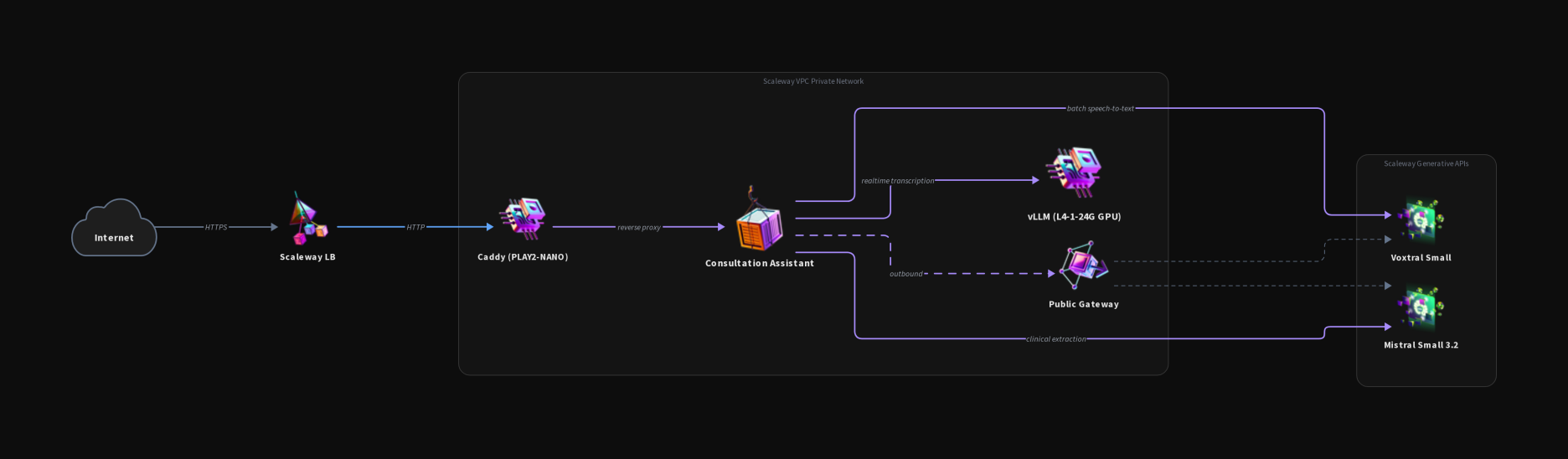

In this use case the doctor-patient conversation audio (file upload or realtime WebSocket streaming) is being transcribed and processed to extract valuable clinical data.
The Consultation Assistant works in two modes:
- In the live mode, the microphone streams audio live via WebSocket to a Voxtral Mini 4B Realtime LLM model hosted on a dedicated L4-1-24G GPU Instance. The model transcribes the audio to text.
- In the batch mode (deffered processing), audio is sent for transcription to a Voxtral Small model running on a pre-configured serverless API endpoint.
The transcribed text is sent for analysis to a Mistral Small 3.2 model running on a serverless endpoint that results in a structured JSON file with clinical information.
2. Document Intelligence
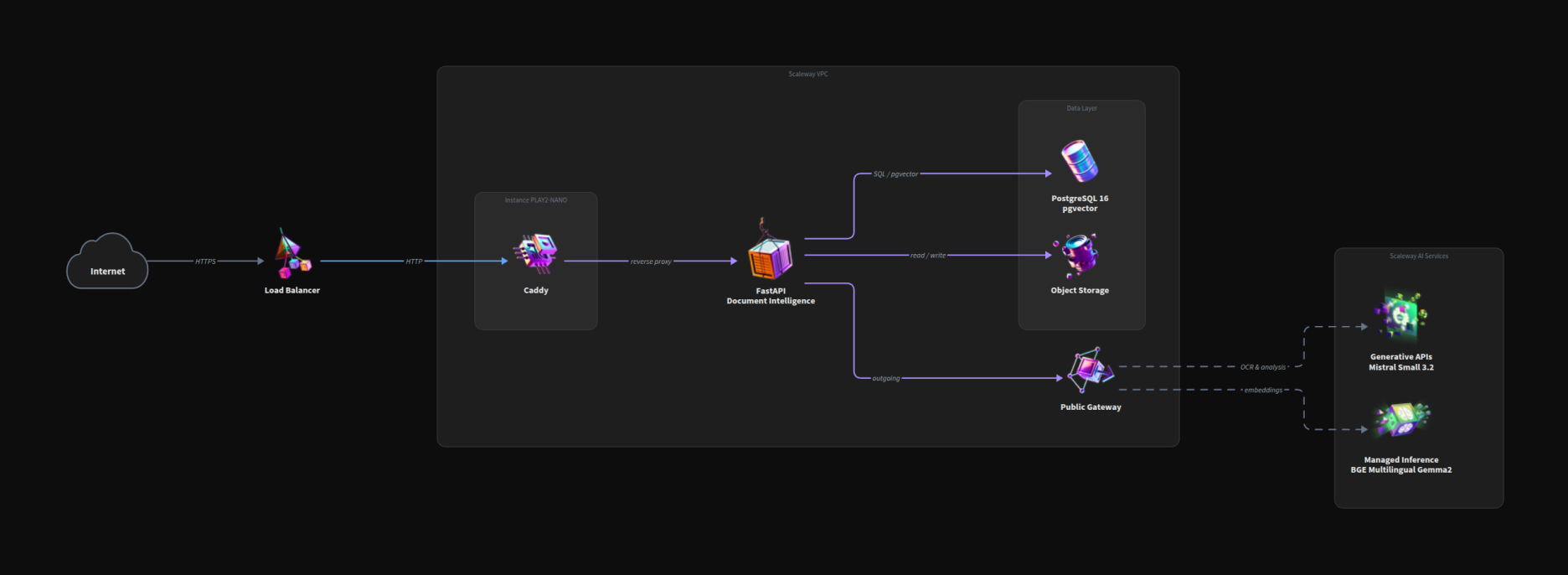

In this use case the AI model performs vision extraction on scanned medical documents, indexes them and answers questions with citations.
Documents, uploaded by user in PDF format, are stored in Scaleway Object Storage.
Mistral Small 3.2 Vision reads and understands the document content (including images and text) and extracts key information through OCR and analysis.
Managed Inference, now called Generative API Dedicated Deployment, (BGE Multilingual embeddings) converts the document content into mathematical vectors stored in PostgreSQL 16 with pgvector for fast searching.
When users ask questions, the system searches the vector database and Mistral Small 3.2 model generates accurate answers with citations back to the source documents
3. Drug Interactions
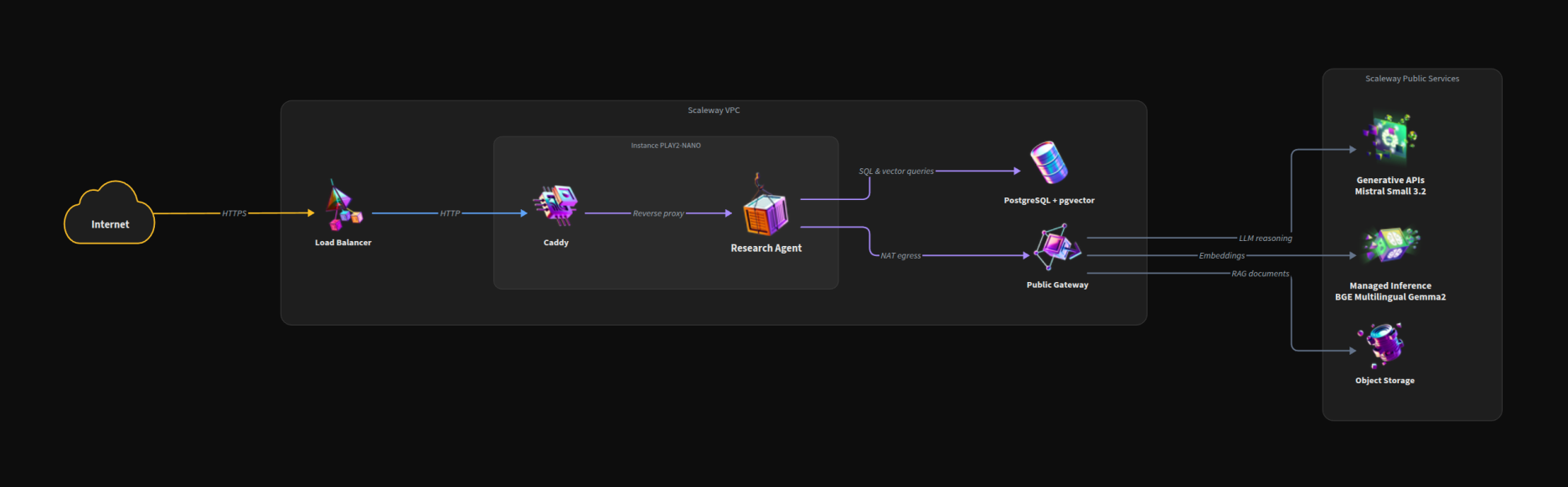

In this use case a ReAct agent analyzes drug-drug and drug-population interactions against openFDA drug labels with cited evidence.
The system receives medication names and patient population data through a secure HTTPS connection. Mistral Small 3.2 ReAct Agent acts as a research assistant, which uses “tool calling” to know when to search databases, compare drugs, or check interactions. The agent reasons through the query step-by-step
PostgreSQL with pgvector stores drug information from openFDA drug labels
Managed Inference converts drug data into searchable vectors. The system finds relevant drug interactions by meaning, not just keyword matching. Findings are severity-ranked (most dangerous interactions first) and every finding includes citations back to source data.. Results stream in real-time via SSE (Server-Sent Events) for instant feedback.